Augusta, GA · Garage Door Service
Is Your Old Garage Door Worth Fixing, or Time to Replace It
Augusta homes built 1966-2007 with mostly 1980s-90s hardware often just need repair, not replacement. Here's how to tell the difference before you call anyone.
- Repairs & new doors
- Springs & openers
- Serving 5 nearby communities
Doing Nothing For Now
If your door is loud but still opens square, closes flush, and the panels aren't bent, you can usually wait. Most of the stock around Augusta went up between 1966 and 2007, with a heavy concentration from the 1980s and 90s across the twelve areas we see work in, from North Augusta and Clearwater in close to Grovetown and Harlem further out. A door from that window was built to a standard that still holds up fine mechanically even after decades of daily cycles. Surface rust on the track, a dry hinge pin, a spring that groans on the way up - none of that means the door is done. It means it hasn't been lubed in a while.
What changes the math is whether the door still tracks straight. A door that drifts to one side, binds halfway, or drops suddenly isn't a maintenance problem anymore, it's a safety one, and waiting on that is the one place doing nothing costs you. Everything short of that, you can leave alone for now and it won't get meaningfully worse by next month.
What to Look At First
Start with the springs, since they're the part most likely to fail without warning on a door from this era. A torsion spring on a house built in the 1980s or 90s has likely gone through its full rated cycle count by now, even if it looks fine sitting still. Next, check the rollers - steel rollers from that period wear grooves into the track over fifteen, twenty years of use, and a grooved track will fight the door no matter what you do to the opener.
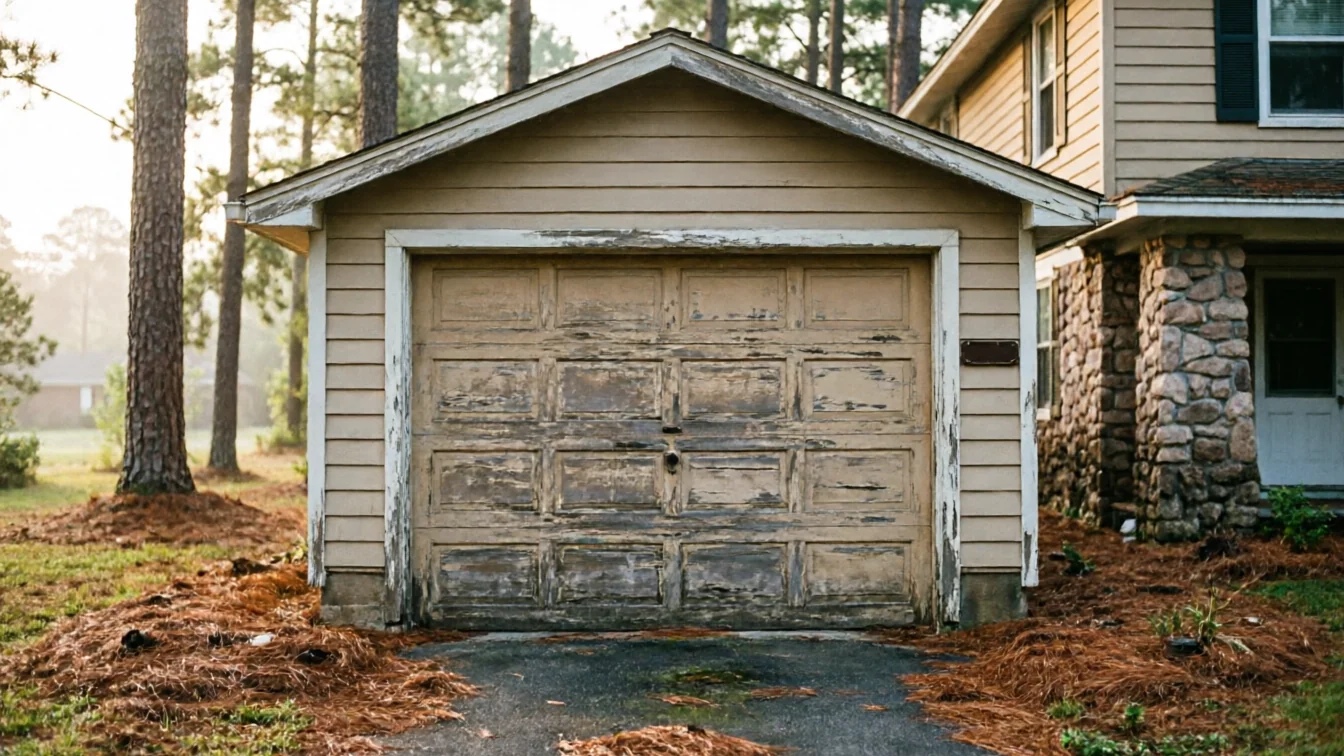
Look at the bottom panel too. Houses in this age range mostly used steel sectional doors, and the bottom section takes the brunt of weather and ground moisture. Rust starting at the bottom corners is common and usually doesn't mean the whole door is bad - it means that one panel might need swapping.
Last, pull the release cord and move the door by hand. If it's heavy or uneven, something's wrong with the spring tension, not the opener. People replace openers to fix spring problems more often than you'd think, and it doesn't work.
The Problem
The doors causing the most calls right now are the ones installed during the original build-out of these neighborhoods, somewhere in that 1966 to 2007 range, median around 1985. That's old enough that the springs are well past a reasonable service life, but the steel itself, the track, the panel structure, is usually still sound. That gap is exactly why replacement gets oversold - a worn spring and a worn door look like the same problem from the driveway, and they're not.
We don't try to save every door. If the bottom panel has rusted through in more than one spot, or the track is bent badly enough that it's been reshaped by hand more than once, replacing it is the honest answer and we'll say so. But a door from this era with intact panels and a straight track is, more often than not, a spring and hardware job, not a full swap. Treating every older door as a replacement candidate is how people end up spending three times what the actual problem cost.
What the Weather Here Does to It
Augusta sits in a mild climate band with only occasional freezes, so we don't see the cracked wood panels or ice-jammed tracks that wreck doors further north. What we do see is rust, from humidity sitting on steel hardware year-round, and that's a slower, quieter kind of damage. It shows up first on the bottom bracket and the track bolts, not the parts people usually check.
The occasional freeze still matters, though. A hinge or roller with surface rust that's fine most of the year can seize up on the one or two cold mornings a winter brings, and that's usually when people notice something's actually wrong. It's rarely the door failing outright - it's a part that's been quietly degrading all year finally getting pushed past its limit by one cold snap. Keeping hardware lubricated through the humid months does more for a door's lifespan here than anything you'd do to winterize it in a colder state.
Frequently asked questions
My garage door is from the 1980s. Is it too old to fix?
Not on its own. A lot of the housing stock around here dates to the 1980s and 90s, and the steel track and panel structure from that era hold up fine. What usually needs attention is the spring and roller hardware, not the door itself. We'd need to look at the panels and track condition before calling it either way.
Why does my door only act up on cold mornings?
Augusta's climate is mild with just occasional freezes, so hardware with quiet surface rust can seize on the handful of genuinely cold days a year. It's not the cold damaging the door - it's rust that built up over the humid months finally getting pushed past its limit.
Should I replace the opener or the door?
Check the springs and track first. People often replace an opener to fix a problem that's actually a worn spring or a grooved track, and the opener swap doesn't solve it. If the door moves heavy or uneven by hand with the opener disconnected, the problem is the door hardware, not the opener.
Related garage door services in Augusta
More garage door guides
Book garage door service in Augusta
Call now or request a quote - tell us what the door is doing and where you are.