Augusta, GA · Garage Door Service
A Broken Spring on a Cold Morning in Augusta
Augusta homes built from the 1960s through the 2000s see springs fail more in cold snaps. Here's what to check first and what the freeze does to aging torsion hardware.
- Repairs & new doors
- Springs & openers
- Serving 5 nearby communities
Doing Nothing For Now
If the spring let go overnight and the door won't budge, leaving it shut is the right call for a day or two. A torsion spring under tension that's already broken isn't going to get worse sitting still, and trying to force the door up on the opener alone can strip the trolley or bend the top panel. Most of the housing stock in this service area went up between 1966 and 2007, with a lot of it concentrated in the 1980s and 90s across the twelve communities we cover - North Augusta, Clearwater, Belvedere, Burnettown, Gloverville, Graniteville, Grovetown, Hephzibah, Jackson, New Ellenton, Blythe, and Harlem. That means a lot of doors out there are original hardware pushing thirty-plus years, and a spring that age doesn't need much of a reason to go. Cold mornings are one of the reasons. We're not saying wait a week - a dead spring means the opener is doing work it isn't built for every time someone hits the button - but you don't have to treat it as a middle-of-the-night emergency either. Keep the car out, keep the door down, and call when the shop opens.
What to Look At First
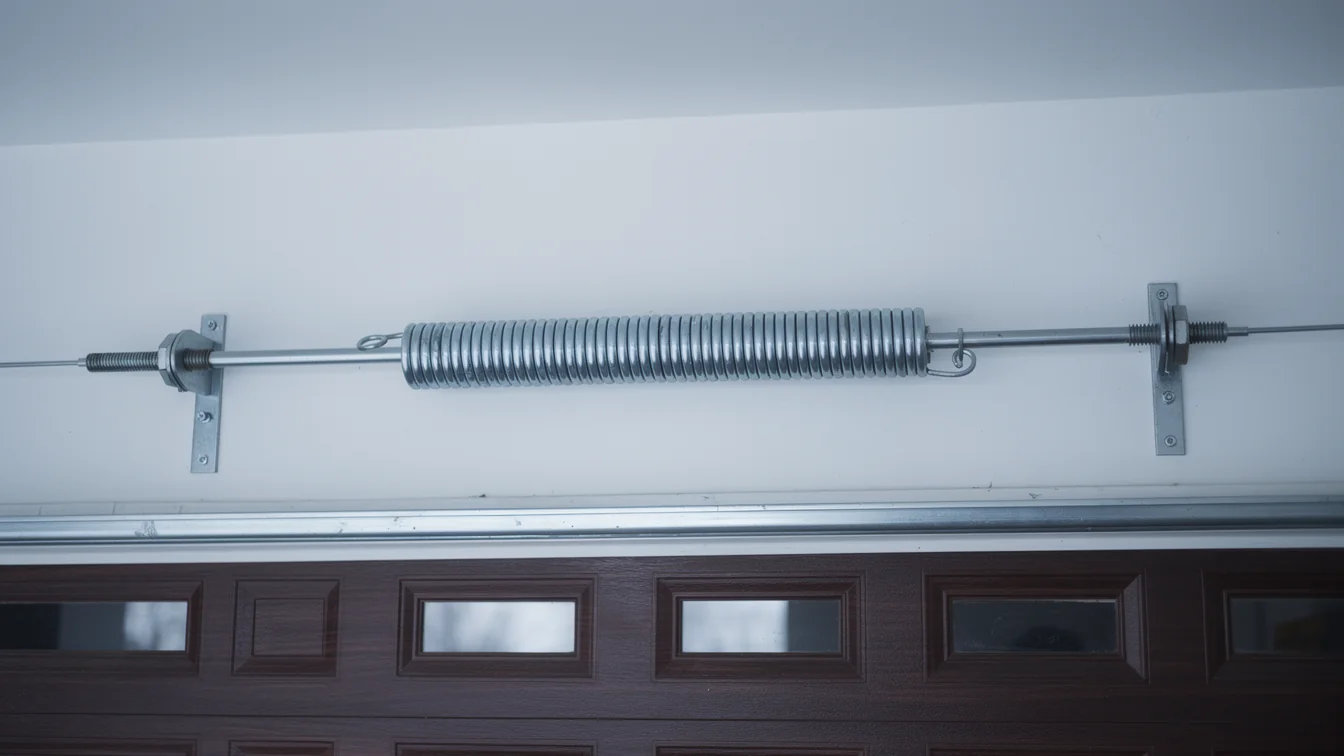
Look at the spring itself before you touch anything else. On a torsion setup, that's the coiled spring mounted horizontally above the door, and a break usually shows as a visible gap in the coil with the two ends pulled apart. On older homes in this area, especially the 1980s-era builds that make up most of the stock here, you'll often find a single spring doing the work of what a newer code-compliant install would split across two - which means when it fails, you've got nothing holding the door at all. Next, check the cables on either side of the door for slack or fraying; a spring failure puts sudden strain on them and they sometimes go next. Don't lift the door manually more than once to test it - each pull without spring tension stresses the track mounts. If the opener is still trying to run, unplug it so the motor isn't working against a dead spring.
The Problem
The core issue in a service area built out mostly between 1966 and 2007 is that a lot of torsion springs are original or close to it, rated for a cycle count they've long since used up. Steel fatigues with every open and close, and a spring near the end of its life doesn't give much warning - it just finally snaps on whatever morning happens to be the coldest one that week. This isn't a design flaw specific to any one builder; it's just metal doing what metal does after a few decades in a garage that swings from summer heat to winter cold with the door as the only insulation. The fix is straightforward on paper - replace the spring, ideally both if it's a double-spring setup so they wear evenly - but on houses from the 80s and 90s, the mounting hardware itself is sometimes outdated enough that a like-for-like swap isn't the cleanest option. We'll tell you straight if your setup is one where replacing the spring alone is a short-term patch rather than a real fix.
What the Weather Here Does to It
This area sits in a mild climate with occasional freezes, not the hard winters that crack concrete or warp steel tracks outright. But that occasional freeze matters more than people expect, because the metal in a thirty-year-old spring has already lost some flexibility, and a sudden cold snap tightens it just enough to push a fatigued coil past its breaking point. It's less about the cold itself and more about the swing - warm fall days into a sharp overnight drop, which is exactly the pattern this region sees a handful of times each winter. Houses here aren't built with the spring in mind for weather extremes, because historically they haven't needed to be. That's exactly why a spring that's been fine for twenty years can go on one particular morning when the temperature finally dips far enough - the cold isn't causing the failure, it's just the trigger that finds the weak point.
Frequently asked questions
Why did my spring break in the morning instead of some other time?
Cold overnight temperatures tighten a spring that's already fatigued from years of cycles. Mornings are when the metal is coldest and least flexible, so a spring that's been close to failing for a while often finally lets go right then, especially after one of this area's sharper overnight drops.
Is my door safe to open if I hear a loud bang but it still moves?
No. A bang usually means the spring broke, and if the door still moves on the opener, the motor is lifting weight it was never built to carry alone. Stop using the opener, leave the door down, and get the spring replaced before operating it again.
Should I replace one spring or both?
If your door runs on two torsion springs and one has failed, the other is usually close behind since they wear at the same rate. Replacing both at once is the more common approach on double-spring setups so you're not back for a second call a few months later.
My house is from the 1980s - is that why this keeps happening?
A lot of homes in this area were built in the 80s and 90s, and original hardware from that era is now well past the cycle count most springs are rated for. Age, not a specific defect, is usually the reason springs from that period are the ones failing now.
Related garage door services in Augusta
More garage door guides
Book garage door service in Augusta
Call now or request a quote - tell us what the door is doing and where you are.